Solvent process · CO
Sugarcane EA
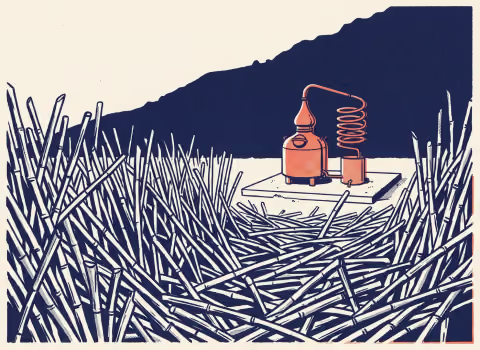
Ethyl acetate fermented from sugarcane molasses, used as an extraction solvent in Colombia. The sweetest-cupping process and the one whose marketing is furthest from its chemistry.
Also sold as: EA · ethyl acetate · sugarcane process · natural process decaf · EA decaf. Same process.
- Solvent
- Ethyl acetate
- Caffeine removed
- minimum 97%
- Trademarked name
- No, generic
- Where it runs
- Descafecol, CO
Beans are steamed for around thirty minutes to open the structure, then submerged for roughly eight hours in a water and ethyl acetate solution that is changed repeatedly as it loads with caffeine. Ethyl acetate is a polar ester that binds caffeine and, to a degree, caffeine’s salt complexes with chlorogenic acids. The beans are steamed again to strip residual solvent, then dried, polished and bagged.
The EA is produced by fermenting sugarcane molasses, hence the name on the bag, and hence most of the confusion about it.
Where “chemical-free” marketing breaks down
Ethyl acetate is a solvent, molasses-derived or not. In the EU it sits in Annex I Part I of Directive 2009/32/EC: permitted under Good Manufacturing Practice with no numeric residue limit, unlike dichloromethane (2 mg/kg in roasted coffee) or methyl acetate (20 mg/kg).
That “no numeric limit” is worth reading carefully. It is a looser form of control, not a stricter one. The obligation is on manufacturing practice rather than on a measured ceiling. Cafe Imports state a maximum of 10 ppm residual EA in the bean. For scale, a ripe banana carries roughly 200 ppm naturally.
The taste claims, sorted
The “sweet, caramel and chocolate” description is well supported. Sucafina describe the result as “balanced, chocolatey and sweet”, and a corpus analysis of UK EA decafs found caramel and chocolate dominating the flavour fingerprint with citrus in about a third of the coffees.
The claim that EA leaves a bready or toasty character has no credible source behind it. The note with an actual mechanism is fruity: ethyl acetate is a fruity-smelling ester, and both Sweet Maria’s and decaffeinate.co.uk report a faint sweet-fruity character.
Residual note
Cafe Imports' process sheet states a minimum of 97% of all caffeine originally present. Descafecol separately claim 99.7% in their own testing. There is no 99.9% standard here.
On the solvent
Ethyl acetate is a solvent, molasses-derived or not. In the EU it sits in Annex I Part I of Directive 2009/32/EC, permitted under Good Manufacturing Practice with no numeric residue limit.
In the cup
Balanced, chocolatey and sweet is well supported. A corpus analysis of UK EA decafs found caramel and chocolate dominating, with citrus in about a third. A faint sweet-fruity character has an actual mechanism behind it: ethyl acetate is itself a fruity-smelling ester.
Stated as a tendency, not a rule. No published head-to-head sensory comparison of the processes exists, so this is trade consensus plus tasting. The green coffee and the roast matter more than the process.
Questions
- Is sugarcane EA decaf natural?
- The ethyl acetate is fermented from sugarcane molasses, but molasses-derived ethyl acetate is chemically identical to any other ethyl acetate. It is a solvent process. "Natural" describes the sourcing of the solvent, not the absence of one.
- Is ethyl acetate in decaf safe?
- It is permitted in the EU under Good Manufacturing Practice with no numeric residue limit. Cafe Imports state a maximum of 10 ppm residual EA in the bean; a ripe banana carries roughly 200 ppm naturally.
- What does sugarcane EA decaf taste like?
- Balanced, chocolatey and sweet, with caramel dominant and citrus in a minority of coffees. Some report a faint sweet-fruity character, which has a plausible mechanism: ethyl acetate is itself a fruity-smelling ester.
Sources
Industry · Cafe Imports, 2023
Does not say Molasses-derived ethyl acetate is chemically identical to any other ethyl acetate. The sugarcane origin is a sourcing fact, not a difference in what touches the bean, and "natural" on this basis is marketing.
Regulation · European Parliament and Council, 2009
Does not say It does not certify any process. Swiss Water and Mountain Water fall outside it entirely because they use no extraction solvent. That is an exemption, not an endorsement.
Who sells Sugarcane EA decaf
- FriedhatsAmsterdam
- Wide AwakeBrussels
Sugarcane EA coffees tasted
Colombia El Carmen — After Hours
“Juicier than I expected from a decaf, and it didn't stop when I swallowed.”
Colombia Siete Soles — No-Caf
“The milk chocolate never showed up, but the florals and dates make it an easy evening cup.”