Water process · CA
Swiss Water Process
A water-only process run at a single plant in British Columbia, using coffee extract already saturated with everything except caffeine. The best known name in decaf, and the most misunderstood. It is a company guarantee, not a certification.
Also sold as: Swiss Water · SWP · water process decaf. Same process.
- Solvent
- None
- Caffeine removed
- 99.9% (supplier guarantee)
- Trademarked name
- Yes: Swiss Water Decaffeinated Coffee Inc.
- Where it runs
- Swiss Water, CA
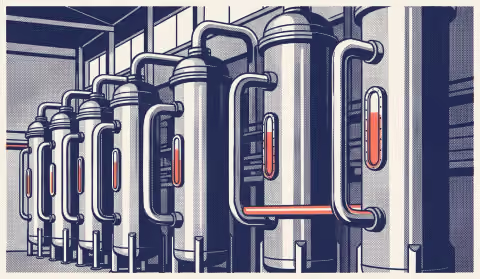
Green beans are hydrated so the cell structure swells and opens, then circulated in Green Coffee Extract, water that has already been saturated with every water-soluble compound in coffee except caffeine. Because the extract has no room left for anything else, only caffeine follows the concentration gradient out of the bean; the sugars, acids and aromatic precursors have nowhere to go.
The caffeine-loaded extract is then passed through activated carbon that traps caffeine specifically, and the regenerated extract goes onto the next batch. The cycle runs about eight to ten hours.
What the 99.9% claim actually means
Swiss Water state, in their own words, that they guarantee any decaffeinated green coffee coming out of the process is 99.9% caffeine free. That is a supplier guarantee attached to their process, not a threshold set by a certification body, and not a number that transfers to other processes.
This matters because the figure has escaped. It turns up on Mountain Water bags and in roaster copy for processes that make no such claim. If you see 99.9% next to a process that is not Swiss Water, check where it came from.
Taste
Trade consensus is that Swiss Water has the least impact on origin character. Sweet Maria’s put it as “we think the Swiss Water process has the least impact on original flavor”. That is consensus, not a published finding. No head-to-head sensory comparison has been run.
Regulatory status
Non-solvent, so it falls outside the residue limits in Directive 2009/32/EC entirely, and it retains organic certification. Worth being precise: falling outside a solvent regulation is an exemption, not an endorsement by it.
Residual note
The 99.9% figure is Swiss Water's own guarantee about its own process. It is not a threshold set by a certification body and it does not transfer to other water processes.
On the solvent
Water, green coffee extract and activated carbon. No extraction solvent, which places it outside Directive 2009/32/EC entirely.
In the cup
Trade consensus, not laboratory finding, is that it has the least impact on origin character. Typically clean, chocolate and caramel leaning, with some loss of the most volatile aromatics.
Stated as a tendency, not a rule. No published head-to-head sensory comparison of the processes exists, so this is trade consensus plus tasting. The green coffee and the roast matter more than the process.
Questions
- Is Swiss Water decaf chemical-free?
- It uses no added solvent, only water, green coffee extract and activated carbon, so it is solvent-free in the sense people usually mean. "Chemical free" is marketing language and not a technical claim; water is a chemical.
- Where does Swiss Water decaf come from?
- One facility in Delta, British Columbia, operating since 1988. Every bag labelled Swiss Water has passed through it, which is worth knowing if you think about freight miles.
- Does Swiss Water remove all the caffeine?
- No. Swiss Water guarantee 99.9% caffeine-free green coffee out of the process, which still leaves a measurable amount in the cup, typically a few milligrams.
Sources
Industry · Swiss Water Decaffeinated Coffee Inc., 2026
Does not say The 99.9% figure is not a certification-body threshold and does not transfer to other water processes. Mountain Water is frequently quoted at 99.9% on the strength of this number; Descamex themselves claim above 97%.
Regulation · European Parliament and Council, 2009
Does not say It does not certify any process. Swiss Water and Mountain Water fall outside it entirely because they use no extraction solvent. That is an exemption, not an endorsement.